

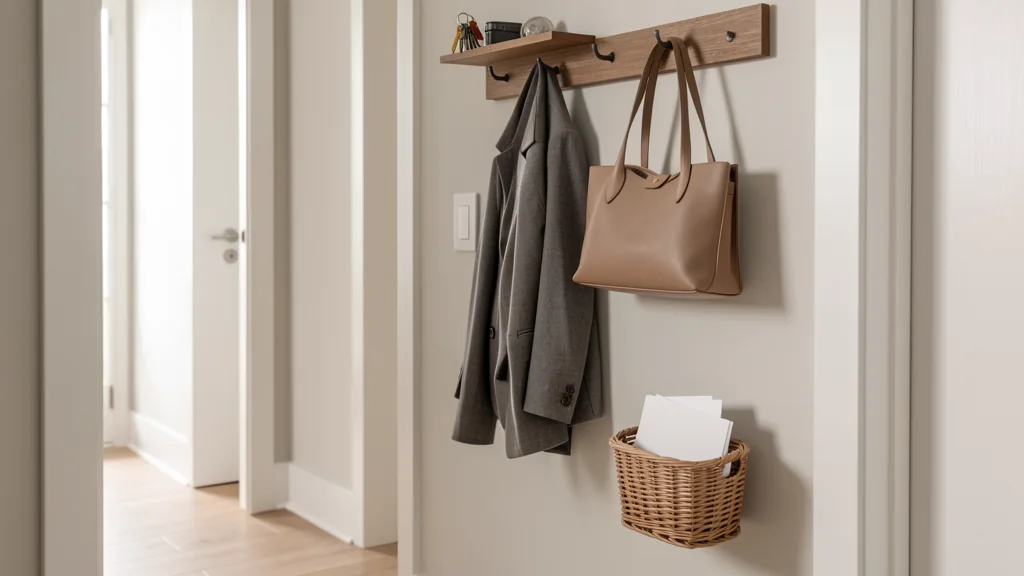
A home drop zone is a small transition point where the items in your hands get an immediate next place. Keys land in one dependable spot, bags stop blocking walkways, and incoming mail enters a short decision process instead of spreading across the nearest table.
The right drop zone is not a large mudroom or a styled entry display. It can be one wall, part of a closet, the end of a cabinet, or a compact station near the door you actually use. Its job is to support arrival and departure with the least possible motion while keeping the route through the home clear.
Observe the arrival path before choosing a location
For several ordinary arrivals, notice where people pause, remove a bag, search for keys, or set down mail. The most convenient wall on a floor plan may not be the place behavior naturally happens. A successful home drop zone belongs at the first safe pause after entering, not across the room behind a closed door.
Account for the full movement of the door and the route to adjacent rooms. The station must not narrow an exit, cover controls, or create a floor obstacle. Respect lease terms, building rules, and product installation instructions before attaching anything. If the ideal location cannot safely hold storage, place the station at the next natural pause rather than forcing it.
Include all regular users in the observation. An adult may enter through the garage while a teenager uses the front door. You may need one main station and a very small key return point, or a shared location where the paths meet. Avoid building two complete systems unless separate entrances truly require them.
Define what the zone is allowed to hold
Name the objects that routinely arrive in hands or on shoulders: keys, everyday bags, mail, reusable grocery bags, outerwear, sunglasses, transit cards, or a dog leash. Then separate permanent drop-zone residents from items that only pass through. A leash may live there; a grocery bag full of food should continue to the kitchen.
Exclude objects with no arrival or departure role. General household papers, tools, toys, and undecided donations will consume the station if “near the door” becomes the only rule. A narrow purpose is what keeps the zone small.
Design separate lanes for keys, mail, and bags
Keys need a small, exact target. Mail needs a decision queue. Bags need weight-bearing space with enough clearance. Combining them in one large basket may look simple, but it forces people to dig through paper under straps to find a key.
| Item | Best landing method | Reset trigger |
|---|---|---|
| Keys | One labeled hook, dish, or closed location per routine | A key is missing from its assigned place |
| Incoming mail | Shallow upright tray or sorter for unprocessed paper | Paper reaches the marked capacity line |
| Everyday bags | Rated hook, cubby, shelf, or floor slot outside the walkway | A second bag competes for the same space |
| Outgoing items | Small basket or shelf clearly distinct from incoming items | Item leaves on its assigned trip |
| Outerwear | Suitable hook or nearby closet position | Seasonal or unused pieces crowd daily gear |
| Small accessories | Divided tray for a tightly limited set | A section no longer closes or remains readable |
The exact hardware depends on your wall, furniture, household, and belongings. Capacity should match an ordinary day, not every object that might enter during a holiday gathering.
Give every key a precise home
Choose whether keys should be visible or concealed based on the entrance, household preferences, and access needs. In either case, assign a specific location. A single hook labeled by person, vehicle, or purpose removes the final decision after walking in.
Place the key location where the arrival motion naturally passes but not where it interferes with the door. The best height and format depend on intended users. If you use adhesive or mounted hardware, follow its surface preparation, load, and installation directions.
Separate daily keys from occasional keys
Keys used every day belong in the active zone. Spares and rarely used sets should have another deliberate, secure home. A crowded rack makes the active key harder to identify and encourages unlabeled mystery keys. Review extras separately rather than turning the drop zone into key archives.
Connect key return to one physical action: enter, close the door, place the key. The shorter the sequence, the less likely a counter becomes the substitute.
Turn mail into a flow, not a pile
The drop zone should receive mail briefly, not store paper indefinitely. Use one shallow input tray or upright slot with a visible limit. When mail enters, remove obvious outer packaging as appropriate, separate anything that needs immediate personal attention, and place the remainder in the input.
Do not create many categories at the door. Detailed paper handling belongs at a desk or another suitable work area. The entry station only needs a clear handoff. An “outgoing” slot can hold a letter or return that must leave, but it should be visibly different from incoming mail.
Choose a recurring processing cue tied to household life, such as after a certain routine or before the tray reaches its capacity. Carry the input to the place where decisions can be completed. Return only true outgoing pieces. The tray should come back empty or nearly empty, not retain a permanent lower layer.
Protect private and important paper
If visitors, children, or shared-household members can reach the station, avoid leaving sensitive documents exposed. Use an appropriate closed location or move those items directly to the responsible person. The drop zone’s convenience should not override privacy or required handling.
Store bags by shape and frequency
Everyday bags need a position that supports their weight and does not crush their contents. A properly installed hook may work for a light bag, while a cubby, bench compartment, or floor slot may suit a structured or heavier item. Follow furniture and hardware load guidance rather than guessing.
One active position per regular user creates a natural limit. Extra bags belong in longer-term storage, not layered on the same hook. If work, school, gym, and childcare bags rotate, use a nearby shelf with named spaces, but keep the departure path obvious.
Empty items that should not remain in bags as part of arrival. Food, damp clothing, paperwork, and borrowed household objects each need another destination. Send each item onward instead of making the station a lost-and-found department.
Add an outgoing lane
Many entry systems focus on what comes in and ignore what needs to leave. A compact outgoing lane can hold a library book, store return, item for a friend, or form that must travel. Give each object a trip, person, or date cue so the basket does not become general storage.
Place outgoing items where they are visible during departure without blocking the door. If something must accompany a particular bag, attach a note to the bag or place the object directly with it when appropriate. The lane is a prompt, not a guarantee; a calendar or reminder may still be needed for time-sensitive tasks.
Use a “next trip” test
An object qualifies for the outgoing lane only if someone can name the trip on which it should leave. “Someday donation” does not qualify. Donations, returns, and borrowed objects with no planned trip need their own project location until a departure is scheduled.
Choose furniture after testing the footprint
Mark the proposed station with removable tape or cardboard. Open the door fully, carry groceries through, put on a coat, and let household members pass one another. Test at busy times. A slim console may fit by measurement but still catch a bag or create a pinch point.
Begin with containers you already have. A bowl can test key placement, a file holder can test incoming mail, and a sturdy existing hook can reveal bag behavior if it is appropriate for the use. Observe what fills, falls, or remains empty. Buy or install only what solves a confirmed issue.
Make the zone usable for everyone
Intended users should be able to reach their assigned storage and understand its labels. Use words, colors, or simple icons according to household needs, but avoid over-labeling. A clear hook and one tray may need no explanation after a week.
For children, adults should decide which items they may handle and where. Keep hazardous, sharp, valuable, or access-sensitive objects in appropriate locations rather than assuming a high shelf solves every concern. For mobility needs, consider reach range, turning space, visual contrast, grip, and the effort required to open containers.
Shared homes benefit from named capacity. One person’s bag should not displace another’s keys. If an item has no assigned owner, give it a short handoff process rather than leaving it in common space.
Build a two-part reset
The arrival reset takes seconds: keys home, bag in position, mail in input, and pass-through items sent onward. The maintenance reset is less frequent: process paper, remove extra bags and coats, return stray objects, and clear the outgoing lane after trips.
Attach maintenance to a reliable cue instead of a vague promise to tidy. The visible capacity of the mail tray or handoff basket can trigger it. A station that needs a long scheduled cleaning is probably holding too much.
If responsibilities are shared, name who processes common mail, who handles a child’s school papers, and who resets general items. A shared household chore system can formalize those handoffs when the issue extends beyond the entry.
Use the zone to prepare for departure
At the end of the day or before a routine trip, return essentials to the active bag, move a named outgoing item into position, and check that keys are home. This brief preparation transforms the station from a dumping point into a launch point.
Keep a small checklist only if it captures recurring essentials. A long list becomes wallpaper. The physical arrangement should do most of the reminding: keys beside the departure route, active bag in its slot, outgoing item in front of or attached to the correct bag as appropriate.
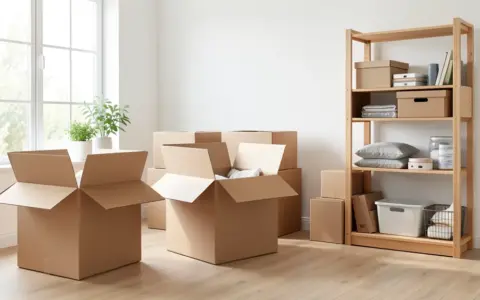
After travel or a move, the drop zone is especially useful because objects may not yet have settled homes. Set up this station early, then use a broader plan to unpack after a move efficiently without allowing boxes to overtake the entry.
Adapt a drop zone to different home layouts
Apartment with a narrow entrance
Use wall-adjacent, shallow solutions outside the door swing: a small key point, one vertical mail holder, and bag storage in a nearby closet. Preserve the walkway instead of insisting that every category occupy the immediate entry.
Home entered through a garage or side door
Build the active station at that entrance if it is suitable, not at a formal front door used only by guests. Keep anything affected by temperature, moisture, or access conditions in an appropriate interior location.
Open-plan room with no entry wall
Use the back of a stable furniture piece, one end of a cabinet, or a defined section inside a nearby closet. A rug or narrow tray can provide a visual boundary, but it should not create a trip or door-clearance problem.
Multiple regular entrances
Identify where paths merge. Keep one main mail and bag station there, while using the smallest necessary key cue at each entrance. Repeated complete stations increase the chance that nobody knows where an item went.
Common drop-zone mistakes
Locating it where you wish people entered
Behavior wins. Put the system on the real route or it will be bypassed by a pile in the actual landing spot.
Using one large basket for everything
Keys, paper, and bags have different next actions. Give each a distinct lane so one category cannot bury another.
Planning for maximum volume
A station sized for every guest coat and possible delivery becomes oversized daily storage. Support normal household use and create a separate temporary plan for unusual volume.
Letting incoming mail become document storage
The entry is for capture, not completion. Process paper at a suitable work location and bring back only outgoing pieces.
Installing hardware without a movement test
Dimensions do not show how straps swing, doors open, or people pass. Test the footprint and follow installation and load instructions.
Giving outgoing objects no deadline or trip
An outgoing basket without a named departure becomes a delayed clutter bin. Require a clear next trip and review the lane during resets.
Review the station after real arrivals
Test the home drop zone through workdays, errands, school departures, and a grocery trip. Notice what lands just outside the boundary. That item may need a better position, a different container, or a direct route to another room.
Do not respond to every stray object by expanding the station. First ask whether it belongs there. If bags consistently miss high hooks, lower or change the approved storage method. If mail stays on the counter, move the input closer to the real path. If the outgoing lane never clears, improve the trip cue rather than buying a larger basket.
Frequently asked questions
Where should a home drop zone be located?
Place it at the first safe, natural pause beside the entrance used most often. It should not obstruct the door, walkway, controls, or required access. When space is tight, use the next nearby wall or closet.
What belongs in a small drop zone?
Prioritize daily keys, active bags, a shallow mail input, and perhaps one tightly limited outgoing area. Outerwear or accessories belong only if the station can hold them without crowding movement.
How do I prevent the mail tray from overflowing?
Give it a visible capacity and a recurring processing cue. Move paper to a proper decision location, complete the decisions, and return the tray empty rather than storing old layers beneath new mail.
Should every family member have a separate section?
Separate positions help for keys and active bags because ownership matters. Common incoming mail may use one shared lane with a named processor. Divide only where separation makes the next action clearer.
Can I create a drop zone in a rental?
Yes. Consider a narrow freestanding unit, existing closet space, an over-door product suited to the door, or removable organizers approved for the surface. Follow the lease, building rules, and product instructions.
Final takeaway
A home drop zone works when it gives each arriving object a short, visible route: keys to one exact home, mail to a limited input, bags to supported storage, and outgoing items to a named trip. Build it on the path people already take, protect the doorway and walkway, and reset it whenever its small boundaries fill. The station then becomes a dependable transition between home and the day ahead, not another place where things wait.